Festi Coder Model
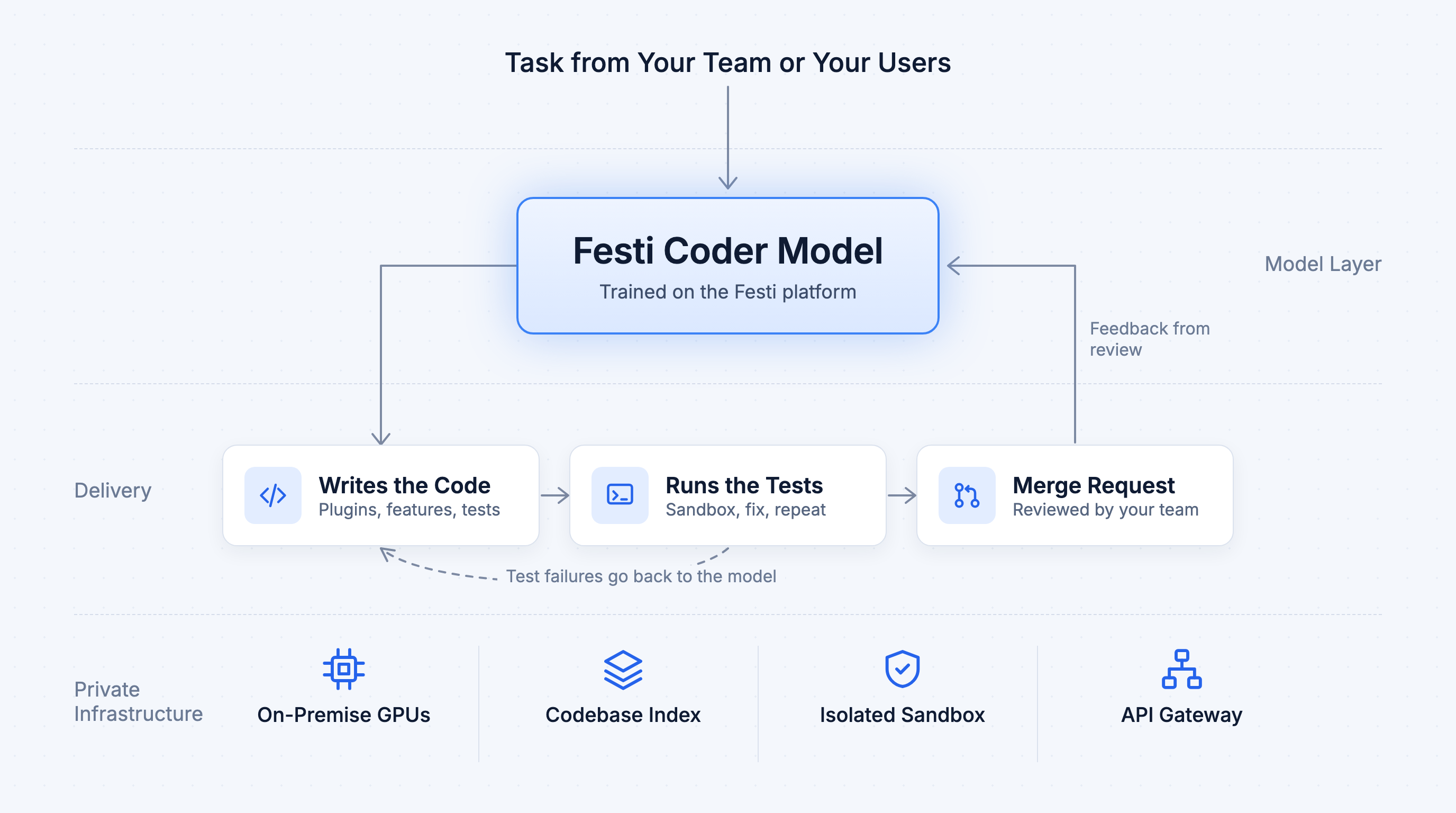
An AI engineer that already knows the Festi platform. Festi Coder builds new projects, plugins, integrations and the tests that prove they work, then hands the result to your team as a merge request.
It runs on private infrastructure, so your source code and customer data never leave your network.
General Models Guess Your Conventions. Festi Coder Was Trained on Them.
Festi is a mature framework with its own plugin architecture, naming rules, test layout and release process. Off-the-shelf assistants produce plausible code that fails on exactly those details, and every correction costs a senior engineer time.
Festi Coder learns directly from real Festi code and from the outcome of running it, not from reading about it. It writes plugins the way experienced Festi developers write them, runs the same tests, and delivers work through the same merge request flow your team already uses.
Three Roles, One Development Loop
Festi Coder is the centre of a small family of models. Each one is tuned for a different kind of work, and together they cover the full cycle from a request to a merged change.

Generates plugins, features, fixes and unit tests in the Festi style. It reasons through a task before writing and follows the conventions of your codebase.
- Plugin and feature generation
- Unit tests from specifications
- Convention-aware refactoring

Works inside a sandboxed development environment. It edits files, runs the test suite, reads failures, iterates and opens the merge request.
- Edit, run and fix loop in a sandbox
- Tool and function calling
- GitLab merge request delivery

The front door. It triages requests from your team and your users, breaks work into tasks, routes each one to the right model and tracks it to completion.
- Request triage and task planning
- Routing across models and tools
- User support answers from your docs
Learned from Real Code, Verified by Running It
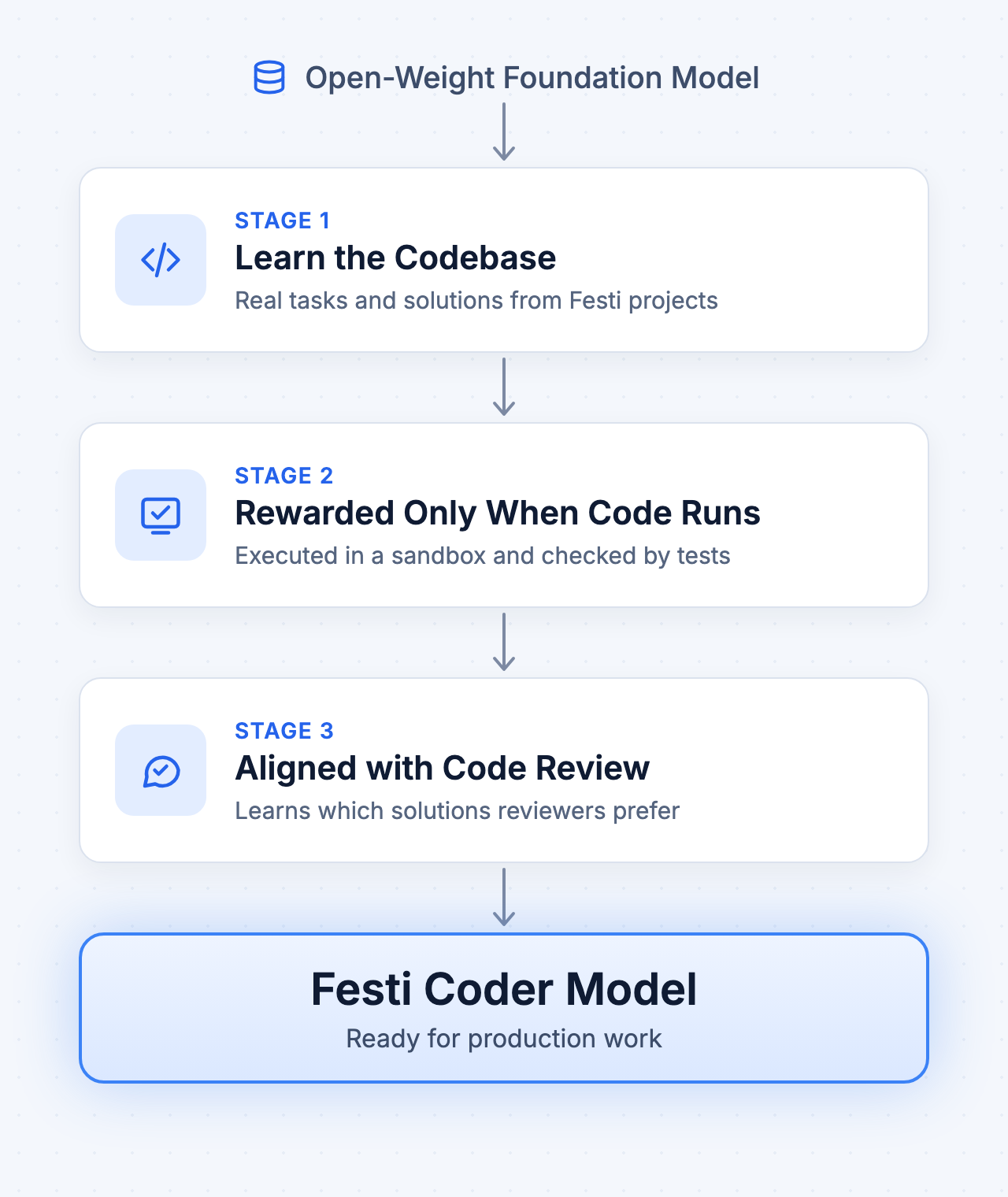
We start from an open-weight foundation model under a commercially permissive license and specialise it in three stages. Every stage is validated on a smaller model first, then scaled up for production.
1. Learn the codebase
Thousands of task and solution examples built from Festi projects teach the model the platform structure, its APIs and conventions, including the reasoning steps a senior engineer takes before writing code.
2. Rewarded only when the code runs
The model output is executed in an isolated sandbox and rewarded only when the code actually runs and passes its tests. The quality of the reasoning is scored too, so the model learns to think well, not just to pass.
3. Aligned with code review
Years of merge request reviews show the model which of two solutions reviewers prefer. This final stage aligns its output with how experienced engineers judge code.
Built for Real Engineering Work

Thinks a task through when it helps and answers directly when it does not, so simple requests stay fast.
Native function calling for sandboxes, repositories and your internal APIs.
Valid JSON every time, ready for orchestration and integrations.

A search index over your documentation and source gives the model current project context on every task.
Simple requests go to lighter models and hard ones escalate, which keeps response times and costs under control.

Built on permissively licensed foundations, so it is safe to deploy for your customers.
Private by Design
The model runs on dedicated GPU workstations. Source code, tickets and customer data stay inside your network.
One API gateway isolates tenants, enforces quotas and gives every client the same interface.
The same stack can be delivered to enterprise customers on their own hardware or in their private cloud.
Routing and model choices are checked on real traffic before anything changes in production.
From a Brief to a Working Festi Project
Festi Coder starts a project the way the platform expects it and grows it with the same building blocks your team uses. Any product that runs on Festi is in scope: mobile applications, custom ERP, CRM, learning platforms, customer and partner portals, e-commerce, internal tools, marketplaces and SaaS products.
Scaffold a complete application from a description: structure, configuration, data models and entry points.
Add features through the Festi plugin architecture, wired into existing hooks and conventions.
Connect Festi projects to external services and internal APIs with the platform's own adapters.
Write the unit tests, run them in a sandbox and deliver the result as a merge request ready for review.
Answer first-line questions from your users with responses grounded in your own documentation.
Bring older modules up to current conventions without changing how they behave.
Where It Pays Off
Faster delivery of plugins and fixes, automated test writing and first-line handling of user requests, all without sending proprietary code to third-party services.
- Shorter cycle from ticket to merge request
- Senior engineers review instead of rewriting
- Support answers grounded in your own docs
Companies that build on Festi get the same model as a managed, private deployment: an AI engineer that already knows the platform they are extending.
- Deployed on-premise or in your own cloud
- Tenant isolation through the API gateway
- Licensed for commercial use
FAQs
Want a Closer Look?
We share technical deep dives, evaluation results and deployment plans with teams and partners under NDA. Tell us what you build on Festi and we will prepare a walkthrough for your use case.